
Discipline: Interview with Dr. Becky Bailey

Interview with Dr. Becky Bailey

Dr. Becky Bailey, international expert in childhood education and developmental psychology and founder of Conscious Discipline, discusses discipline and teens.

What is a basic strategy to set limits?
Composure is the key. When limits are established during an upset state, your teen perceives the limit as an attempt to control rather than structures for success. Setting the limit is not the most difficult part; the most difficult part is maintaining your composure when your teens begin to challenge that limit.

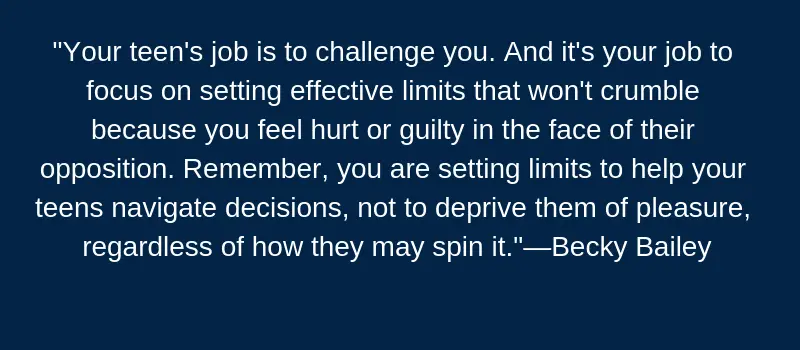
A teen’s job is to challenge you; it’s your job to focus on setting effective limits that won’t crumble because you feel hurt or guilty in the face of their opposition. Remember, you are setting limits to help your teens navigate decisions, not to deprive them of pleasure, regardless of how they may spin it.

Use the following steps to help you set limits:

1) Compose yourself.
2) Take back your power.
You are in charge of your inner state; teens are in charge of their inner states. You are not “making” them angry, and they are not “making” you angry. You are both making the choice to feel angry. You can reclaim power with your words. Try saying, “I’m going to take away your computer” instead of, “You’re
making me have to take away your computer.”
3)
Focus your intention.
You need one intention: To help your teen make decisions that will ensure safety. Dispose of any intention to make them behave or to make them happy. Dispose of any illusion that they will accept your rules without a challenge. All three of these are parenting myths.
4)
Focus on what you want to occur.
In regard to curfew, what you
want is for your teen to be home at a reasonable hour. Work with your teen to define what “reasonable” is for that event. Conclude with stating the limit in very specific terms. For example, “You must be back home no later than 11p.m.”
5)
Stay calm when your teen challenges the limit.
Repeat the choices: “You can go to the party and be back by 11 p.m., or you can stay home. Which would be best for you tonight?”
6)
Set a consequence and deliver it.
Resist the temptation to lecture or lose your composure. Reacting with anger diverts attention from the action to
you, the mean, angry, unfair parent. However, if you dole out the consequence with some empathy, your teens may leave the situation with angst over the mistake instead of angst over your negative reaction.

Consider two scenarios. Curfew is 11 p.m., and your teen returns at 11:30 p.m.  The predetermined consequence is that he will lose the opportunity to use the car.

Option 1.
Deliver lecture: What was our agreed upon time? You want me to trust you, but how can I trust you if you are not going to do what you say you will? You want to be treated like an adult, but you act like a child. And don’t even think about giving me any of that nasty mouth of yours. One more word about losing your car privileges, and you’ll be grounded for the rest of the month.

Option 2.
Deliver the consequence (with empathy): Our agreement was 11 p.m., but you came home at 11:30 without calling. I worry that you are not safe when you disregard our agreed-upon curfew. Next time, you will not be able to drive the car. You can choose between being dropped off and picked up at the party, or not going at all. Then, I will know you are safe and home at the correct time.

Teen Response (with “attitude”): This is unfair! It was just 30 minutes. What do you mean “safe”? You are always safe, safe, safe. I am not a child!

Parent Response (with empathy): It’s hard to lose your driving privileges. You can handle this. End the conversation with assurance.

Is there ever an appropriate time to negotiate?
Definitely. However, negotiating must happen during “ice cream” moments, not during the crisis. In the heat of the moment, negotiating is counterproductive because one or both of you will likely be emotionally triggered. Useful negotiating can only happen after a cool-down period.

If things don’t go the way you had hoped, use the “24-hour” rule. Twenty-four hours later, you and your teen can discuss what worked and what didn’t. The emotionally charged event is over, and hopefully it will be easier to hear each other’s perspective.

Should teens participate in defining the rules and consequences?

Absolutely.  We refer to “rules” as “agreements” for that very reason. A joint creation of guidelines allows you to share power while maintaining your safety expectations. When setting agreements, visualize a fence around the issue in your mind. For example, if the issue is Facebook time, explain your concerns that your teen may rush through homework to get on the computer or may stay up late into the night on the computer. Define the broad guidelines (fences), and then discuss the details. Once they have shared their online priorities, the next step is to negotiate. You may suggest an electronics dock where everyone (including you and your spouse) places computers and cell phones at a designated hour each night. When agreements are created together, the quantity of consequences and policing needed by your teens will be considerably less.

The most important detail for consequences is timing. Never create consequences during or directly after highly emotionally charged times. Wait several hours or until the following day to discuss your agreement and that it was broken. The goal is to make the breach an opportunity to teach them, not “nail” them.

Most learning experiences happen when parents are in a relaxed, alert state.  Yet, this state does not magically happen. In order to achieve successful consequences, you must make a conscious decision to respond to, instead of react to, upsetting situations.

What are some obvious rules for teens?

Each adult’s moral compass dictates what is appropriate for each child at each age. Helping teens regulate school and social experiences is a full-time job. Yet, the rules you establish are much less important than your relationship with your teen. Spend the bulk of your time talking to your teens about their interests (sports, drama, friends, schools) instead of trying to control them by catching them, getting them to do something or forcing them do something. Discipline is like gardening. The investment you make in the development of the soil represents the relationship we must establish with our teen. This relationship provides connection, and connection is essential for cooperation and willingness.  As we observe the growth of the garden we will see occasional weeds.  The pulling of the weed represents actions we need to take in moments of upset (drinking, overusing cell phones, disregarding curfew, skipping school). If you ignore the weeds in your garden they will quickly spread just as if you ignore your teen’s poor choices. The more time that is spent cultivating the soil, the healthier the plants will be and the fewer weeds you will have in your garden.

Can you share some examples of good consequences?
Consequences are about teaching, not punishing or rescuing. In our childhood, a ball through the neighbor’s window had consequences. Our parents marched us over to the neighbor’s house for a confession and an apology. Then we had to pay for the window, which meant we took on additional chores. While we did these jobs, we missed TV time, special events with the family and playtime. The core of the learning did not come from missing the activities or suffering (though, these things weren’t particularly fun); the learning came from the uncomfortable feeling we had as we walked over to the neighbor’s house. In our fast-paced society, we have robbed children from truly experiencing consequences because we want their life to be swift and effortless.

The best consequence is a natural consequence. Again, focus mainly on how you deliver the consequence. At emotionally-charged times, we give our teens a free “pass.” When we yell and threaten, they respond by saying that we are picking on them: “It’s not fair. I hate you.” The consequence essentially becomes about our upset, not their behavior. In your delivery of a consequence, avoid redirecting your teen’s focus to you by:

The best consequence is a natural consequence. Again, focus mainly on how you deliver the consequence. At emotionally-charged times, we give our teens a free “pass.” When we yell and threaten, they respond by saying that we are picking on them: “It’s not fair. I hate you.” The consequence essentially becomes about our upset, not their behavior. In your delivery of a consequence, avoid redirecting your teen’s focus to you by:
·Stating consequences in a clear, calm and assertive voice without shouting.
·Creating consequences that are respectful, reasonable and related to the offense.
*Late for curfew? Move up curfew an hour for the rest of the month.
*Returned the car without refilling it with gas? Remove car privileges for the week.

When your consequences meet the above guidelines, you are heading in the right direction.

When do you tolerate their “attitude” and when do you forbid it?
Apply the Q-TIP method (Quit Taking It Personally) and instead:
1) See your teen’s attitude as a call for help.
2) Seek to connect instead of control.
3) Speak from your heart.

Teen “attitude” is often a reflection of feelings that teens can’t communicate constructively. When a teen rolls her eyes, she is really saying, “I am very frustrated,” but she doesn’t possess the maturity to express her feelings in a socially acceptable way. Our typical reaction usually teaches teens to withhold their feelings rather than manage them. We have to teach our children how to navigate through their upset (or attitude) instead of asking them not to get frustrated, irritated or upset. This expectation is not realistic.

Instead of ignoring the attitude, choose to compose yourself and tell yourself something different. Instead of thinking, “Here we go again,” try to think, “She is really irritated and doesn’t have the words to let me know.” Overlay the attitude with empathy. For example, if your teen says, “This is just stupid. You’re such a bitch,” you could respond with, “You were hoping you could get poor grades and continue to stay out late. It’s hard. You can handle this.” Later, after your teen is calmer, say, “Calling names in this family is not helpful or acceptable. When you feel so angry say, ‘I disagree,’ and take some breaths.”

A tug-of-war game is a great visual for teen attitude.  The teen throws out the rope by saying something disrespectful. As the adult, we either decide to pick up the rope and pull (get offended and argue our point) or stay composed and let the rope dangle there. When we pick up the rope, the teen will always follow by tugging back with more hurtful statements. When we choose to stay composed, we leave the teen with the discomfort of his or her feelings.

Choosing not to take their words personally requires us to understand that their attitude is their way of calling for help. Some words to get you started in this process are:
You seem….
You wanted….
You were hoping….
It is hard. You can handle this.

How do you back down on a bad decision?
Allowing your teens to realize that you make mistakes is a gift to your teen. No “backing down” is necessary. Instead, model for your teen that sometimes time can give everyone a new perspective. Often, the reason for our new perspective is because we have left a highly emotional state and returned to the thinking state of our brain where reflection is natural. Teens feel an enormous amount of pressure if they are taught they must make the correct decision the first time. We need to model making the most informed decision in the moment, and adjusting our decision later when other information is revealed.

What do you recommend when parents disagree on limits and consequences?
When parents disagree, they are typically focused on what they don’t like about the other spouse’s thinking. With this approach, a line in the sand is drawn and nothing productive is achieved. Understand that each person’s perspective is created from a personal experience from their past. Ask the question, “Do I want to be right or do I want to feel heard?” The only person you have any control over changing is yourself. When you choose to let go of justifying why your view is the correct view and truly open your mind to hearing your partner’s perspective, all of a sudden you are both communicating instead of building your case.

An important way to get on the same page is to focus on the end goal. Try to agree on what behaviors you expect. Do you want teenagers who feel safe enough to call home if they find themselves in a tough situation (drunk at a party)?  Do you want your teenagers to accept responsibility for their actions, both successes and mistakes? Start with the big picture, focus on what you want to see and work your way down.

Do you think parents should drink in front of their teenage kids?
Taking part in legal activities for adults teaches children how to manage the activities for themselves. Drinking is certainly one issue in which you can model personal responsibility. Driving a car is another opportunity to teach. Some adults drive above the speed limit or text while driving. This models inappropriate ways to handle the opportunities extended to adults. Modeling the appropriate ways to handle our activities teaches teens how to balance the responsibilities of adulthood.

Do parents generally follow the patterns from their childhood?
Yes, the choices we make when parenting are directly related to our personal past. We can consciously become aware of those experiences and choose to parent with a different style. This does not come from blame, shame or guilt, but from a conscious awareness of what is currently happening in the present moment. Much of parenting is spent worrying about what might happen in the future or punishing ourselves for not doing it correctly in the past. Don’t waste time on what should happen; instead, assess the current situation and plan your response. It is key to stay present in the moment, learn active calming techniques so we can remain calm in stressful moments, recognize how our past affects our emotional triggers and consciously choose to do it differently.

“Pick your battles.” But how do you know which battles to pick?
I think the advice to “pick your battles” reflects the notion that teenagers will challenge the limits set and the consequences delivered. There can be no battle if you are not willing to argue. If you can stay calm, offer choices, repeat them calmly and walk away, then there will be no battle (just an outraged teenager trying to engage you in one).

Often, choices can help alleviate the need to pick your battles. For example, if you want your teen to come home at midnight and you believe it will be a battle, simply say, “Tonight are you coming home at 11:30 or 12. Either works for me.” If you are okay with them being on Facebook for an hour say, “I know you have some homework to finish, so will you choose to be on Facebook for 30 minutes or an hour tonight?”

What if parents impose rules that deviate from the community norm?
You are the safety keeper of your teen. Safety – physical, emotional, academic, social and financial – should always be at the core of your decision-making. No other person knows your teen better than you.

The boundaries and consequences you create with love for your child will yield positive results. If you create boundaries and set consequences as a team, you will minimize your frustration, regardless of the boundaries. If, on the other hand, you dictate what your teen must do, you model “bullying” qualities. Your teen will respond by becoming completely submissive or rebelling. Either trait results in the teen not using the problem-solving brain state. When we have “obedient” children, they are generally doing it “because we say so.” The potential problem is that as they grow up, they will easily become obedient to peers. This is sometimes referred to as caving into peer pressure. In many cases, parents say to their teens, “What were you thinking, would you jump off a bridge if they told you?” If you do not actively engage your teen in the problem-solving process of setting boundaries within your home, your teen’s response to this could be, “I was not thinking because you did not teach me to think, you taught me to obey. I’m just choosing not to obey you now; I’m obeying my peers.” Sharing power with your teen does not mean you’re lenient. It simply means you are teaching and modeling how to manage all the opportunities life offers together.

Many people feel teens are going to test some risky behavior anyway, so should parents create safe environments for the testing? Does that condone the behavior?  This seems like a personal value question. The law states that it is illegal to drive alone at 15-years-old, drink before 21-years-old, text while driving, etc. If you choose to break the law and allow the behavior, it is difficult for a teen to understand which laws to obey and disobey. There are many ways to teach impulse control to your child without allowing them to drink before the legal age. This skill set is the same as the one that helps you restrain yourself from becoming overindulgent with shopping, food, video games, etc. The science of the brain explains that impulse control is not attained through stamina training. Impulse control and decision-making skills are acquired through healthy prefrontal lobe development.

Also see the Setting Limits Without Guilt audio lecture, available at www.ConsciousDiscipline.com

Comments (2)

  1. E. Torma says:

    It makes good sense and gets to the heart of the teenager/parent relationship. I hope many teens read this and share with their parents. And parents read and share with their teenagers!

  2. K. Martin says:

    I’m afraid I’m too guilty of over-reacting during stressful conversations. This article has some great common-sense suggestions for getting through those heated times.

Comments

Leave a Reply

Your email address will not be published. Required fields are marked *

*

* Copy this password:

* Type or paste password here:

Follow Us!

Don't miss a thing...subscribe!

Cleveland Clinic Children's Hospital Kent State College of Public Health

Virtual Family Blog Posts