

If you love solving riddles and figuring out trick questions, chances are you also love brain teasers. These brain teasers can make you question what seems obvious and look at a problem in a new way. Some have simple answers hiding in plain sight while others take a little more patience. We’ve gathered brain teasers for kids, teens, and adults, along with answers for when you get stuck. Try them on your own or challenge your friends and family to see who can figure them out first. These are great to share while on a road trip, in a classroom, at dinner, or the car ride home from school.
What are Brain Teasers?
Brain teasers are puzzles and questions that challenge you to think carefully and find clever solutions. Some use word play or trick questions, while others involve math or logic. Part of the fun is figuring out an answer that seemed impossible at first. They also give you practice looking at problems differently and paying attention to small details. Another fun part about brain teasers is sharing them with friends and family to see if they can be stumped!
Easy Brain Teasers
These easy brain teasers are a good place to start. If these are too easy for you, then you can check out the more difficult ones later in the list. Just because these are easier brain teasers doesn’t mean you’re expected to get all of them correct! Just go through them and have fun!
- Before people identified Mount Everest as the world’s highest mountain above sea level, which mountain was the highest?
Answer: Mount Everest. Its height did not depend on people knowing about it. - Which weighs more: one pound of feathers or one pound of bricks?
Answer: Neither. Both weigh one pound. - What disappears the moment you say its name aloud?
Answer: Silence. - Which word is spelled “incorrectly” in every standard English dictionary?
Answer: Incorrectly. - What becomes larger as you remove more from it?
Answer: A hole. - If you possess it, you may want to share it. Once you share it, it is no longer yours alone to keep. What is it?
Answer: A secret. - What appears once in “minute,” twice in “moment,” and never in “a thousand years”?
Answer: The letter M. - What walks on four legs in the morning, two at midday, and three in the evening?
Answer: A human. A baby crawls, an adult walks on two legs, and an older person may use a cane. The times of day represent stages of life. - The person who makes it does not need it. The person who buys it does not use it. The person who uses it does not know they are using it. What is it?
Answer: A coffin. - What runs without legs, has a mouth without speaking, and has a bed without sleeping?
Answer: A river.
Hard Brain Teasers
Ready for a bigger challenge? These hard brain teasers may take a few tries, so give yourself time to work through the clues before checking the answers.
- You have two ropes and a lighter. Each rope takes exactly one hour to burn from one end, but burns unevenly, so half a rope does not necessarily burn in half an hour. You may light either end. How can you measure exactly 45 minutes?
Answer: Light both ends of the first rope and one end of the second. When the first rope finishes, 30 minutes have passed. Light the second rope’s other end. Its remaining 30 minutes of burn time will take 15 minutes, giving you 45 minutes total. - There are 100 coins on a table, exactly 10 showing heads. You cannot see or feel which side any coin shows, but you may move and turn over coins. How can you make two piles containing equal numbers of heads?
Answer: Separate any 10 coins and turn over every coin in that pile. If it originally contained three heads, the other pile contains seven heads, and flipping the selected pile gives it seven heads too. The same reasoning works for any selection. - Remove two diagonally opposite corner squares from a chessboard. Can you cover the remaining 62 squares with 31 dominoes, each covering two adjacent squares?
Answer: No. Opposite corners have the same color, leaving 30 squares of one color and 32 of the other. Every domino covers one square of each color, so a complete covering is impossible. - You have 25 horses and a track that holds five at a time. You have no stopwatch, so each race tells you only finishing order. Each horse’s speed stays constant, and there are no ties. What is the fewest races needed to identify the three fastest horses?
Answer: Seven. Race five groups of five, then race their winners. Call their groups A through E in the winners’ finishing order. A1 is fastest overall. Only A2, A3, B1, B2, and C1 can still finish second or third overall. Race those five; its first two finishers complete the top three. - You have two identical eggs and a 100-story building. There is a fixed highest floor from which an egg survives a drop. Eggs survive every lower drop and break at every higher drop. An intact egg can be reused. What is the fewest drops needed to guarantee finding the threshold in the worst case?
Answer: Fourteen. Test the first egg at floors 14, 27, 39, 50, 60, 69, 77, 84, 90, 95, 99, and 100, stopping when it breaks. Use the second egg to test the untested floors in that interval from lowest upward. The shrinking intervals keep the total within 14 drops. Thirteen drops can cover only 91 floors. - A parent says their three daughters’ ages, expressed as positive whole years, multiply to 36. Their ages add up to the house number across the street. A friend looks at the number but says there is still not enough information. The parent adds that there is one uniquely oldest daughter. What are the ages?
Answer: Two, two, and nine. The only possible age combinations sharing a sum are 1, 6, 6 and 2, 2, 9; both add to 13. A uniquely oldest daughter rules out 1, 6, 6. - Cheryl’s birthday is one of these dates: May 15, May 16, May 19, June 17, June 18, July 14, July 16, August 14, August 15, or August 17. She privately tells Albert the month and Bernard the day. Albert says he does not know the date but knows Bernard does not know either. Bernard says he initially did not know, but now does. Albert then says he knows too. When is her birthday?
Answer: July 16. Albert’s first statement eliminates May and June, which contain uniquely identifying days. Bernard’s statement eliminates July 14 and August 14. Albert can then know only if his month is July, leaving July 16. - Draw nine dots in three evenly spaced rows of three. How can you pass through every dot using four connected straight lines without lifting your pen or retracing a line?
Answer: Start at the top-left dot. Draw right across the top row, extending one dot-spacing beyond it. Draw diagonally down-left through the middle-right and bottom-middle dots, ending directly below the bottom-left dot. Draw straight up through the left column to the top-left dot. Finish diagonally down-right through the center and bottom-right dots. - Exactly one of 1,000 bottles contains poison. A test strip turns positive overnight if any poison touches it. Each strip can receive samples from multiple bottles, and you have time for only one round of testing. What is the fewest strips needed to guarantee identifying the poisoned bottle?
Answer: Ten. Give each bottle a unique ten-digit binary code. Put a sample from each bottle onto every strip corresponding to a 1 in its code. The pattern of positive strips identifies the bottle. Ten strips distinguish 1,024 possibilities; nine distinguish only 512. - You and your spouse attend a party with four other couples. Nobody shakes their own hand or their spouse’s, and nobody shakes the same person’s hand twice. You ask the other nine people how many hands they shook and receive nine different answers. How many hands did your spouse shake?
Answer: Four. The answers must be 0 through 8. The people answering 0 and 8 must be spouses; then 1 and 7 must be spouses, followed by 2 and 6, and 3 and 5. The remaining person, your spouse, answered 4.
Funny Brain Teasers
If you’re doing brain teasers for entertainment, then you should try to stick to these funny brain teasers! These mostly incorporate some form of word play or joke. Check them out and share with a friend!
- An electric train travels north while the wind blows south. Which direction does its smoke blow?
Answer: It produces no exhaust smoke because it is an electric train. - A passenger plane crashes directly on the border between two countries. In which country should the survivors be buried?
Answer: Neither. Survivors are alive. - A rooster lays an egg on the peak of a roof. Which side will the egg roll down?
Answer: Neither. Roosters do not lay eggs. - How many animals of each kind did Moses take aboard the ark?
Answer: None. In the biblical story, Noah took the animals aboard, not Moses. - You enter a dark cabin carrying one match. Inside are an unlit candle, an oil lamp, and a fireplace. What do you light first?
Answer: The match. - Can a man marry his widow’s sister?
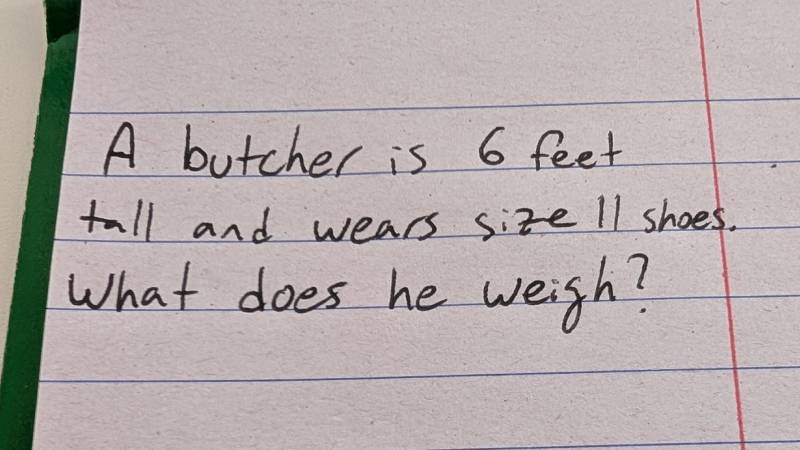
Answer: No. If he has a widow, he is dead. - A butcher is six feet tall and wears size 11 shoes. What does he weigh?
Answer: Meat. - A man shaves several times every day but still has a beard. How is that possible?
Answer: He is a barber who shaves other people. - A bus driver goes the wrong way along a one-way street, passing several police officers. Nobody stops him. What could explain this?
Answer: He is walking, not driving. - A person wearing entirely black clothing crosses a road. A car approaches with its headlights off, but the driver sees the person and stops. There are no streetlights. How?
Answer: It is daytime. - A man walks in heavy rain without a hat or umbrella. His clothes become soaked, but no hair on his head gets wet. Why?
Answer: He is bald. - A house has only one story. Its walls, doors, and floors are all yellow. What color are the stairs leading to the second story?
Answer: There are no such stairs because the house has no second story. - A cowboy rides into town on Friday, stays three days, and rides out on Friday. How?
Answer: His horse is named Friday. - A man pushes his car toward a hotel. When he arrives, he realizes he is bankrupt. What happened?
Answer: He is playing Monopoly, and his playing piece has landed on an expensive property. - A woman shoots her husband, puts him underwater, and hangs him up. Later, they enjoy dinner together. How?
Answer: She photographs him, develops the photograph in liquid, and hangs the print to dry. - Two U.S. coins total 30 cents. One of them is not a nickel. What are the coins?
Answer: A quarter and a nickel. The quarter is the coin that is not a nickel. - Two tennis players each play five sets, and each wins three of them. How can this happen?
Answer: They are partners playing doubles, so both win the same three sets. - A rope ladder hangs over the side of a freely floating boat, with its bottom rung touching the water. The tide rises three feet. How many additional rungs become submerged?
Answer: None. The boat and ladder rise with the water.
Math Brain Teasers
If you prefer brain teasers that include math and numbers, then this list is for you! These types of questions usually require some form of unique problem solving that involve math.
- You have an unmarked three-gallon jug, an unmarked five-gallon jug, and unlimited water. How can you measure exactly four gallons without estimating?
Answer: Fill the five-gallon jug and use it to fill the three-gallon jug, leaving two gallons. Empty the smaller jug and transfer those two gallons into it. Refill the larger jug, then pour into the smaller jug until it is full. Four gallons remain in the larger jug. - You have a seven-minute hourglass and an eleven-minute hourglass. How can you measure exactly 15 minutes, starting immediately?
Answer: Start both. At seven minutes, flip the seven-minute glass. At eleven minutes, flip that glass again. Since four minutes of sand have fallen since its previous flip, it now runs for four more minutes and empties at minute 15. - Eight coins look identical. Seven weigh the same, and one is heavier. How can you identify the heavier coin using a balance scale only twice?
Answer: Weigh three against three. If they balance, compare the two remaining coins. Otherwise, take the heavier group and compare two of its coins. If they balance, the third coin is heavier; otherwise, the heavier side identifies it. - Ten bags each contain ten coins. Genuine coins weigh 10 grams each. Every coin in one bag is counterfeit and weighs 9 grams. How can you identify that bag with one use of a scale that displays exact weight?
Answer: Number the bags 1 through 10. Take one coin from bag one, two from bag two, and so on. The 55 coins would weigh 550 grams if genuine. The shortfall identifies the bag: 546 grams means bag four contains the counterfeits. - A bat and a ball together cost $1.10. The bat costs exactly $1 more than the ball. How much does the ball cost?
Answer: Five cents. The bat costs $1.05, making the total $1.10. - Five identical machines make five widgets in five minutes. Working independently at the same constant rate, how long would 100 machines take to make 100 widgets?
Answer: Five minutes. Each machine makes one widget in five minutes. - A patch of lily pads doubles in size each day. It completely covers a pond on day 48. On which day did it cover half the pond?
Answer: Day 47. The final doubling takes it from half covered to fully covered. - A rope fits tightly around the equator of a perfectly spherical Earth. You add one meter to its length and raise it evenly above the surface. How high will the rope sit?
Answer: About 15.9 centimeters, or 6.3 inches. Increasing a circle’s circumference by one meter increases its radius by one divided by two pi meters, regardless of the original circle’s size. - There are 100 closed lockers. On pass one, you open them all. On pass two, you change the state of every second locker. On pass three, every third locker. Continue through pass 100, opening closed lockers and closing open ones. Which remain open?
Answer: Lockers 1, 4, 9, 16, 25, 36, 49, 64, 81, and 100. A locker is changed once for each divisor of its number. Only perfect squares have an odd number of divisors. - Three doors hide one car and two goats. You choose a door. The host knows what is behind every door and always opens another door containing a goat, then always offers you a switch to the remaining unopened door. Should you switch?
Answer: Yes. Switching wins whenever your first choice was wrong, which happens two-thirds of the time. Staying wins only one-third of the time. - What is the smallest number of randomly selected people needed for the chance that at least two share a birthday to exceed 50%? Assume independent birthdays equally distributed across 365 days, ignoring leap days.
Answer: Twenty-three people, giving approximately a 50.7% chance of a shared birthday. - Someone says, “The day before yesterday I was 25. Next year I will turn 28.” How can this be true?
Answer: They are speaking on January 1, and their birthday is December 31. They were 25 on December 30, turned 26 yesterday, will turn 27 later this year, and will turn 28 next year. - You are given three pills and told to take one immediately, then one every 30 minutes. How long until you have taken all three?
Answer: One hour. You take them at zero, 30, and 60 minutes. - A snail is at the bottom of a ten-foot well. Each day it climbs three feet, and each night it slips back two feet. On which day does it escape?
Answer: Day eight. After seven nights, it is seven feet up. Its next three-foot climb reaches the top, so it never slips back that night. - What is the smaller angle between the hour and minute hands of a normally functioning analog clock at 3:15?
Answer: 7.5 degrees. The minute hand points at three, but the hour hand has moved one-quarter of the way toward four. - A clock takes five seconds from its first strike to its sixth strike. If its strikes remain equally spaced, how long does it take from its first strike to its twelfth?
Answer: Eleven seconds. Six strikes contain five intervals, so each interval lasts one second. Twelve strikes contain eleven intervals. - A single-elimination tennis tournament begins with 128 players. Every match eliminates one player, and nobody withdraws. How many matches are needed to produce a champion?
Answer: 127. Every player except the champion must lose exactly once. - What comes next in this sequence: 1, 11, 21, 1211, 111221, 312211?
Answer: 13112221. Each term describes the previous term’s consecutive digits: 312211 contains one 3, one 1, two 2s, and two 1s. - How can you use exactly eight 8s and addition signs to make 1,000? You may combine digits into larger numbers.
Answer: 888 + 88 + 8 + 8 + 8 = 1,000. - An analog clock’s reflection in a vertical mirror appears to show 8:20. What time does the actual clock show?
Answer: 3:40.
Brain Teasers for Kids
These brain teasers are more simple and perfect for kids. There are a lot of benefits to sharing brain teasers with kids. It encourages them to think about problems differently and come up with clever solutions. Additionally, the feeling of accomplishment when they get one right makes the whole thing worth it!
- A farmer must take a wolf, a goat, and a cabbage across a river. The boat carries the farmer and only one animal or item. Left without the farmer, the wolf eats the goat, and the goat eats the cabbage. How can everything cross safely?
Answer: Take the goat across and return alone. Take the wolf across and bring the goat back. Take the cabbage across and return alone. Finally, take the goat across again. - A chocolate bar contains 24 squares arranged in four rows of six. How many breaks are needed to separate every square? Each break splits one existing piece along a groove. You cannot stack pieces or break several pieces at once.
Answer: Twenty-three. Each break increases the number of pieces by one, so going from one piece to 24 requires 23 breaks. - Two fathers and two sons go fishing. Each catches exactly one fish, but they catch only three fish altogether. How?
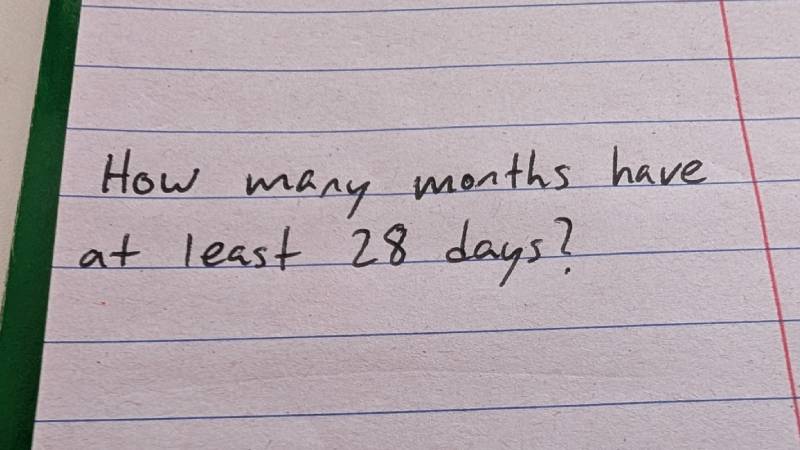
Answer: There are three people: a grandfather, his son, and his grandson. The middle person is both a father and a son. - How many months have at least 28 days?
Answer: All twelve. - A farmer owns 17 sheep. All but nine die. How many sheep remain alive?
Answer: Nine. - Three apples sit on a table. You take two. How many apples do you have?
Answer: Two, the ones you took. - A family has two parents and six sons. Each son has exactly one sister. How many people are in the family?
Answer: Nine. All six sons share the same sister. - Mary’s father has five daughters. Four are named Lala, Lele, Lili, and Lolo. What is the fifth daughter’s name?
Answer: Mary. - What belongs to you but is generally used more often by other people?
Answer: Your name. - What can repeat your words without having a mouth?
Answer: An echo. - What must you break before using its contents to make an omelet?
Answer: An egg. - What becomes wetter while drying something else?
Answer: A towel. - What can travel around the world while remaining in a corner?
Answer: A postage stamp attached to an envelope. - What shows cities without residents, forests without trees, and rivers without water?
Answer: A map. - A drawer contains many black socks and white socks, identical except for color. Without looking, how many must you take to guarantee two socks of the same color?
Answer: Three. If the first two differ, the third must match one of them. - Six glasses stand in a row. The first three are full of water, and the last three are empty. By picking up only one glass, how can you make them alternate full, empty, full, empty, full, empty?
Answer: Pick up the second glass, pour its water into the fifth glass, and put the second glass back in its original position.
Brain Teasers for Teens
If you’re sharing brain teasers with teens, then this section is for you! Brain teasers are commonly used in schools as an ice breaker or a question of the day. If you’re a teacher, you can even give students a small treat for getting them right!
- Three switches outside a room control three bulbs inside, one switch per bulb. All bulbs start off. You can operate the switches however you like, but may enter the room only once. How can you identify which switch controls each bulb? Assume the bulbs become warm when left on.
Answer: Leave the first switch on for several minutes, then turn it off. Turn on the second switch and enter. The glowing bulb belongs to switch two, the unlit warm bulb to switch one, and the unlit cool bulb to switch three. - Two doors lead to safety and danger. Two guards know which is which. One always tells the truth, and the other always lies. You do not know which guard is which. What one question can you ask either guard to identify the safe door?
Answer: Ask which door the other guard would identify as safe. Then choose the opposite door. Either guard’s answer will point to the dangerous door. - Four people must cross a bridge at night. They take 1, 2, 5, and 10 minutes to cross. At most two can cross together, moving at the slower person’s pace. Anyone crossing must carry the single flashlight, which cannot be thrown. How can everyone cross in 17 minutes?
Answer: The 1- and 2-minute people cross together, taking 2 minutes. The 1-minute person returns. The 5- and 10-minute people cross together. The 2-minute person returns. Finally, the 1- and 2-minute people cross together. Total: 2 + 1 + 10 + 2 + 2 = 17 minutes. - How can you arrange six identical toothpicks to form four equilateral triangles of equal size without bending or breaking any toothpick?
Answer: Build a triangular pyramid, or tetrahedron. Its six edges form four triangular faces. - A man looks at a photograph and says he has no siblings, but the photographed man’s father is his own father’s son. Who is pictured?
Answer: His son. Since the speaker has no siblings, his father’s son is himself. - During a race, you overtake the runner in second place. What position are you now in?
Answer: Second place. You have taken that runner’s position. - A house has four walls, each facing south. A bear walks past it. What color is the bear in the classic answer?
Answer: White. The house is at the North Pole, and the bear is a polar bear. - A father and his son are in a car crash. The father dies, and the boy is taken to surgery. The surgeon sees him and says, “I cannot operate. This is my son.” How can that be?
Answer: The surgeon is the boy’s mother. - A woman gives birth to two sons in the same hour, on the same day, in the same year. They are not twins. How?
Answer: They are two members of a set of triplets or another multiple birth. - What has keys, a space, and an enter button, but no locks, room, or doorway?
Answer: A computer keyboard. - Which five-letter word becomes “shorter” when you add two letters?
Answer: Short. Add E and R to make shorter. - Which odd number becomes even when you remove one letter from its written name?
Answer: Seven. Remove the S to get even. - Which five-letter English word sounds the same after you remove its final four letters?
Answer: Queue. The remaining Q has the same pronunciation. - Two brothers compete for an inheritance. The brother whose horse finishes last wins, so both ride as slowly as possible. A wise person gives them advice, after which they race toward the finish. What was the advice?
Answer: Switch horses. Each now wants to finish first so that their own horse, ridden by their brother, finishes last.
Brain Teasers for Adults
Lastly, we have the list that is more tailored towards adults. These brain teasers include puzzles about money, everyday objects, and strange situations that make sense once you uncover the twist.
- You have a candle, matches, and a cardboard box containing thumbtacks. How can you attach the candle to a wall so it burns upright without dripping wax onto the floor? Assume the wall accepts thumbtacks.
Answer: Empty the box, tack it to the wall as a small shelf, and stand the candle inside it. - Two strings hang from a ceiling. They are too far apart for you to hold one and reach the other, but long enough to tie together. You have scissors. How can you join the strings?
Answer: Tie the scissors to one string and set it swinging. Hold the other string, catch the swinging one when it reaches you, and tie them together. - You drive 60 miles at 30 miles per hour. How fast must you drive the same distance back to average 60 miles per hour for the entire journey?
Answer: It is impossible at any finite return speed. A 120-mile journey averaging 60 mph must take two hours, and you have already spent two hours on the outward trip. - Three guests pay $30 for a hotel room. The manager discovers the price should be $25 and sends an employee to return $5. The employee keeps $2 and gives each guest $1. Each guest has now paid $9, totaling $27. Adding the employee’s $2 gives $29. Where is the missing dollar?
Answer: Nothing is missing. The $27 already includes the employee’s $2: $25 went to the hotel and $2 to the employee. The guests’ $3 refund accounts for the rest of the original $30. - One glass contains water and another contains wine. Transfer a spoonful of water into the wine and stir. Then transfer an equal spoonful of the mixture back. Is there more water in the wine glass or more wine in the water glass? Treat the liquids’ volumes as additive.
Answer: The amounts are equal. Each glass finishes with its original volume, so whatever wine is missing from the wine glass has been replaced by exactly that much water. - A man lives on the tenth floor. Every morning he takes the elevator to the ground floor. Returning alone on dry days, he rides only to the seventh floor and walks the rest. On rainy days, he rides directly to the tenth floor. Why?
Answer: He is too short to reach the tenth-floor button. On rainy days, he uses his umbrella to press it. - A man enters a bar and requests water. Instead, the bartender points a gun at him. The man thanks the bartender and leaves without drinking anything. What could explain this?
Answer: The man had hiccups and wanted water to stop them. The fright cured his hiccups, so he no longer needed the water. - Romeo and Juliet are found dead on the floor beside broken glass and a puddle of water. There are no wounds on either body. What happened?
Answer: Romeo and Juliet were fish. Their glass bowl broke, spilling them and their water onto the floor. - A man lies dead in a field with an unopened pack on his back. There are no other people nearby. What is the classic explanation?
Answer: His parachute failed to open. - A coin is inside a bottle sealed with a cork. How can you remove the coin without breaking the bottle or pulling the cork out? Assume the bottle’s neck is wide enough for the coin.
Answer: Push the cork into the bottle, then tip the coin out through the neck. - A town has exactly two barbers. Neither cuts their own hair or goes outside town for a haircut. One has a beautifully cut hairstyle; the other has a terrible one. Whom should you choose if you judge only by those haircuts?
Answer: The barber with the terrible haircut. They cut the other barber’s beautiful hair, while the other barber gave them the terrible haircut. - What is one practical reason a manhole cover might be circular rather than square?
Answer: A circular cover cannot fall through a slightly smaller circular opening, regardless of how it is turned. A square cover can potentially fit diagonally through its opening.